How communities shape who runs and who's told to wait.
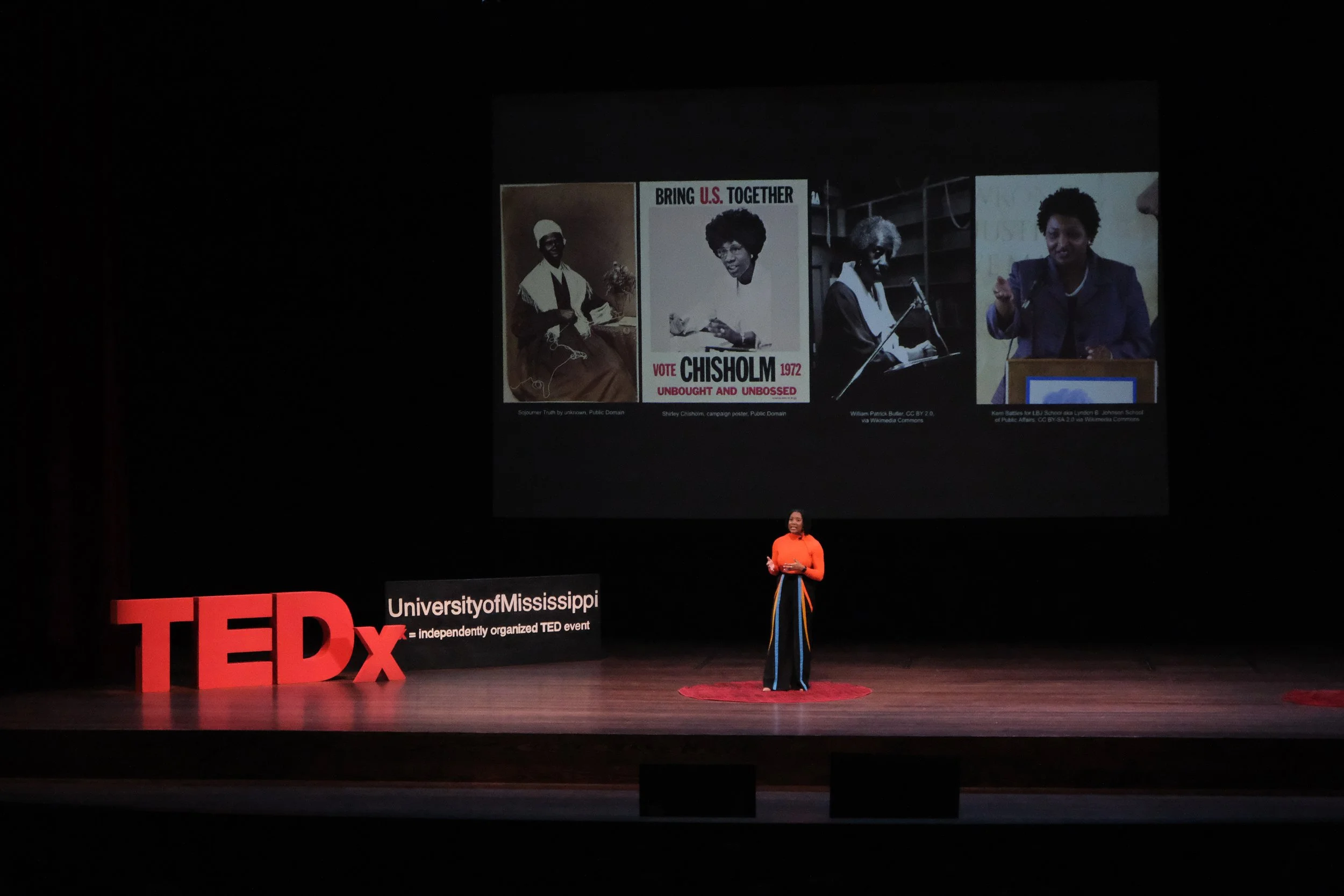
My work sits at the intersection of race, gender, and place: how grassroots organizations shape Black women's political ambition, how communities sustain leadership beyond the campaign, and how rural context changes what representation looks like. I use mixed-methods logistic regression alongside qualitative case studies because the statistics and the stories together tell a fuller truth from different angles.
Five areas, one throughline
-
How Black women navigate overlapping systems of race and gender when pursuing elected office, and how those systems shape who is recruited, funded, and taken seriously as a candidate.
-
How community-based training programs build more than campaign skills, cultivating collective identity, resilience, and a lasting commitment to public service.
-
How rural context shapes political ambition, voter engagement, and pathways to leadership for communities historically left out of national datasets.
-
How women, particularly Black women, build political and organizational leadership capacity: mentorship networks, confidence-building, and the relational skills that carry beyond any single campaign or program.
-
How communities build the civic infrastructure that sustains engagement long after a program ends, and the on-the-ground organizing work that turns leadership into lasting local capacity.
Publications & public scholarship-
An integrative literature review examining how collectivist leadership frameworks shape Black women's leadership development within grassroots political training programs, grounded in illustrative survey data from 88 participants.
-
Under review. Honoring the intellectual and political leadership of Dr. Joanne V. Gabbin.
-
Under Review. An analysis of Black women's friendship networks as a form of collective infrastructure, examined through a Black feminist lens.
-
A public distillation of my dissertation findings, on the democratic importance of grassroots organizations and why real leadership often starts long before someone runs for office.
-
Using factorial logistic regression and categorical data analysis, this dissertation finds that grassroots training builds more than campaign knowledge; it strengthens collective identity, resilience, and commitment to public service.
-
A collaborative civic engagement tool designed to make voter education interactive and accessible.
Teaching as the practice of freedom "As a classroom community, our capacity to generate excitement is deeply affected by our interest in one another, in hearing one another's voices, in recognizing one another's presences; education was about the practice of freedom." — bell hooks
I define community as a collective coming together to share thoughts and build a framework around whatever we're discussing, and I try to build that inside every classroom, regardless of a student's background, religion, or ethnicity. I learned the value of this from my own upbringing, from hearing the stories of those who came before me and learning how to carry those stories into a room.
My methods vary by course: lecture, discussion, and collaboration, but the goal stays the same: real-life scenarios that ask students to think like practitioners, not just students, and texts that model the decisions I want them to be conscious of making. Mentorship continues past the classroom; I meet regularly with students to talk through their reading, their reasons for choosing public service, and the conferences and internships that might shape where they go next.
Courses Taught
-
An introduction to the structure and function of the U.S. government, the Constitution, federalism, the three branches, and the electoral process grounded in real-world case studies rather than abstract civics. Students leave with the tools to actually read the government they're studying, not just recite it.
-
An examination of Black political thought, participation, and representation from Reconstruction through the present, grassroots organizing, the Civil Rights Movement, and contemporary movements for racial justice, and how each has shaped, and been shaped by, American democracy.
-
A study of how power, funding, and policy responsibility shift among federal, state, and local governments, with particular attention to how those relationships shape outcomes for under-resourced and rural communities in practice, not just on paper.
-
A foundational course in the theory and practice of public administration, bureaucratic structure, budgeting, and policy implementation — taught with social equity as a core pillar of administrative practice, not an afterthought.